What AIMS eWaves Pro does
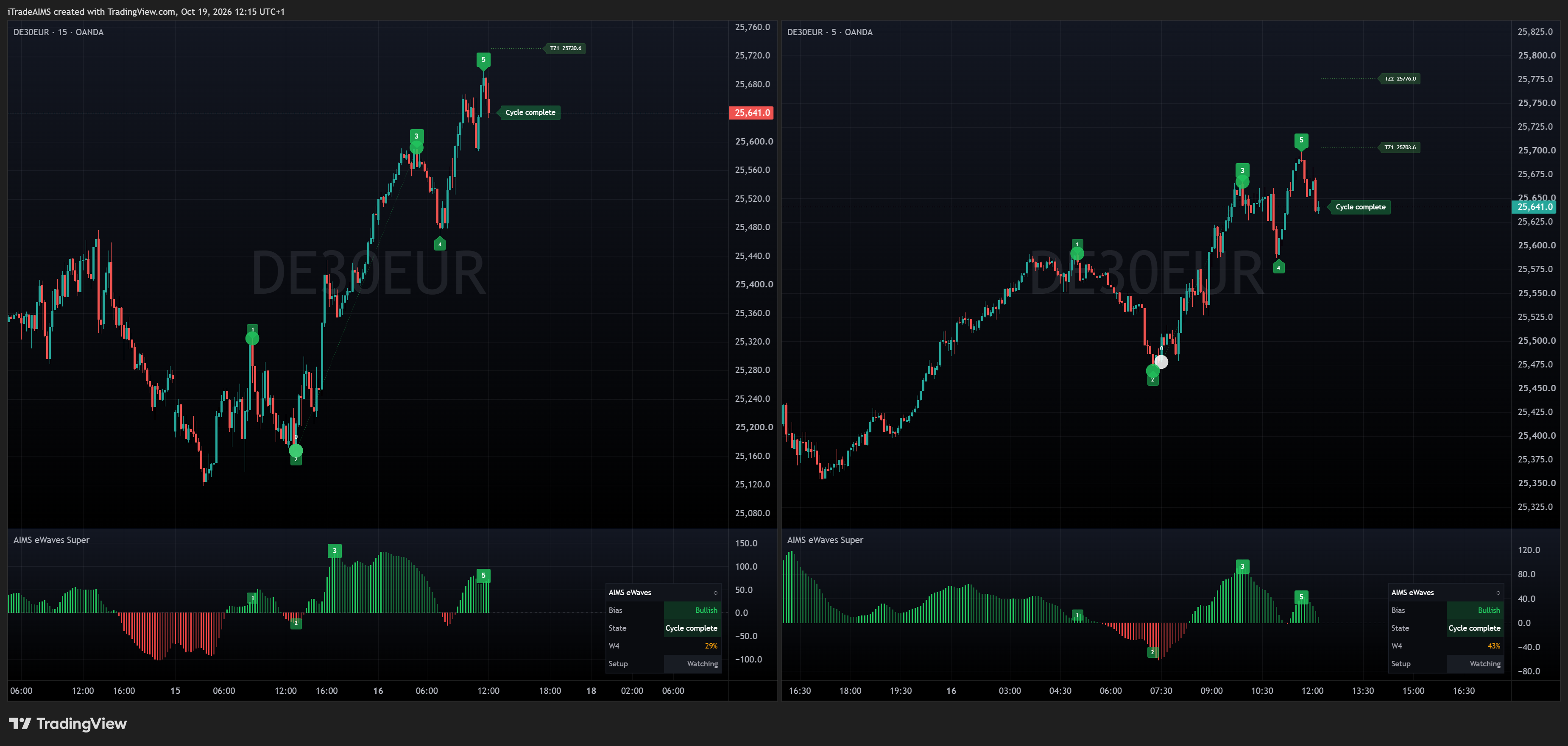
AIMS eWaves Pro represents the pinnacle of institutional Elliott Wave engineering. Engineered for professional desks, prop traders, and quantitative analysts, it replaces simplified oscillator approximations with a price-native ATR-zigzag node chain architecture that continuously tracks multi-degree nested waves with algorithmic confidence ratings.
Price-Native ATR-Zigzag Node Chain
Tracks raw price structure through an adaptive ATR-zigzag node ladder, establishing verified structural swing pivots on candle close.
Multi-Degree Fractal Hierarchy
Simultaneously maps Intermediate, Minor, and Micro wave degrees, allowing macro context tracking and micro pullback execution.
Confidence-Scored Rival Counts
Algorithmically scores competing wave interpretations against Fibonacci ratios and wave rules, surfacing the dominant hypothesis.
How to trade AIMS eWaves Pro
Execute Multi-Degree Hierarchies
Track macro impulse legs on higher degrees while executing micro-degree pullbacks inside the exact same structural corridor.
Arbitrate with Confidence Scores
Trade the primary wave count when its confidence score exceeds 75%, and respect the rival count when scores converge.
Target W4 Forecast Pockets
Identify mathematical confluence boxes where corrective Wave 4 legs have highest statistical probability of terminating.
Respect Objective Invalidation Levels
Anchor stops behind structural swing nodes; clear price levels dictate exactly when a wave count is validated or invalidated.
Prompts, not trade instructions. A SETUP READY prompt tells you to review the structure on a closed candle. It is never a command to enter blindly.
Setups and chart grammar
AIMS eWaves Pro evaluates competing wave hypotheses with mathematical confidence ratings.
| Setup | Context | What the indicator sees | Goal |
|---|---|---|---|
| Primary Impulse Sequence | Established 5-wave expansion | Confidence score > 75% adhering to all cardinal wave rules without overlapping territory | Ride operational impulse legs with structural invalidation pegged behind prior nodes |
| Rival Count Arbitration | Consolidation or complex structure | Multiple competing valid wave interpretations with converging confidence scores | Stand aside or reduce size until node breakout decisively confirms the dominant count |
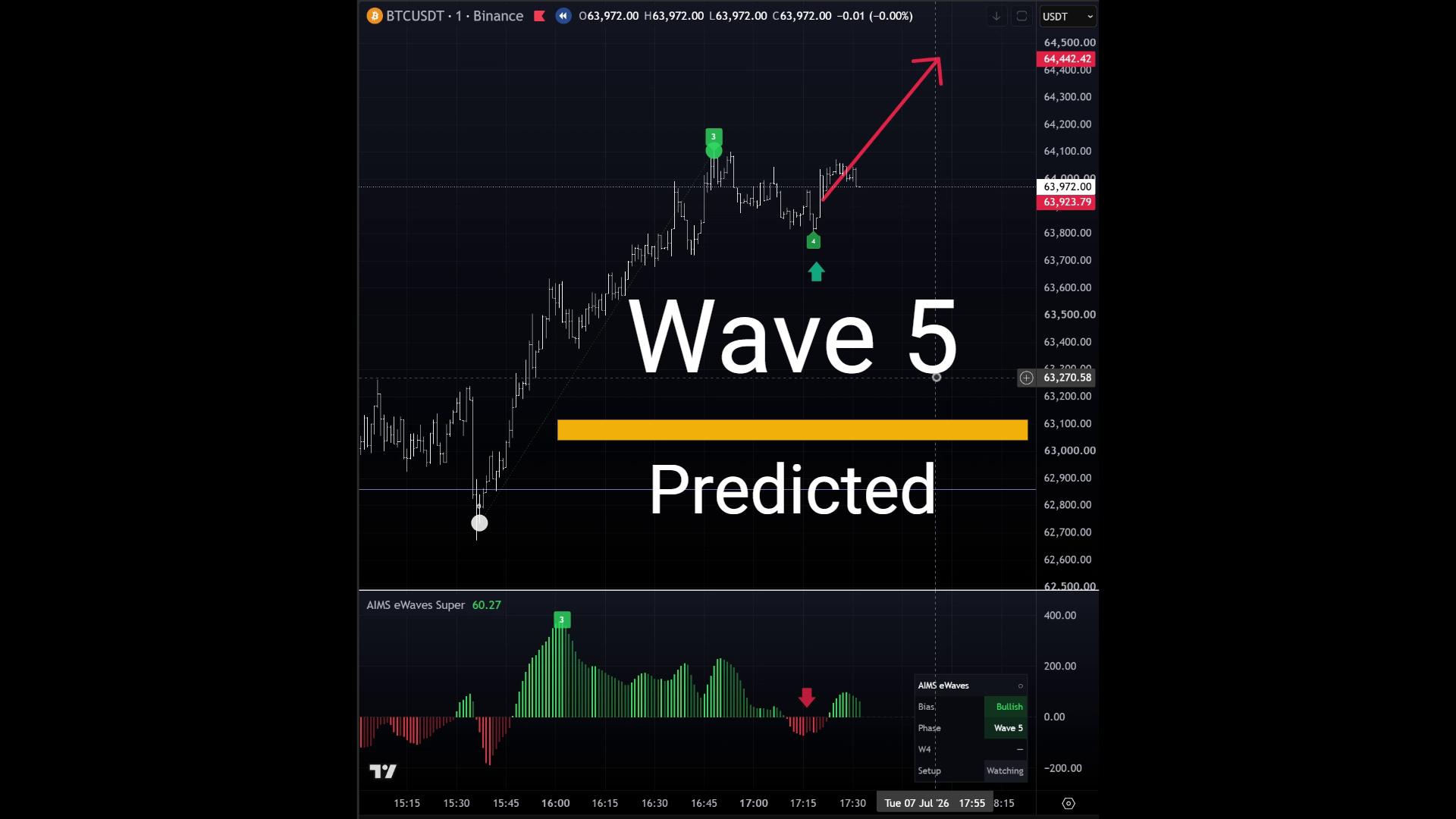
| W4 Fibonacci Forecast Pocket | Wave 4 corrective termination | Price entering 38.2%–50% Fibonacci cluster box with internal micro-degree completion | Enter Wave 5 continuation trades with asymmetric risk-to-reward geometry |
Dominant wave hypothesis with confidence score > 75% in active impulsion.
Competing wave interpretations converging — await node breakout for validation.
Price entering 38.2%–50% Fibonacci forecast pocket — prime structural entry.
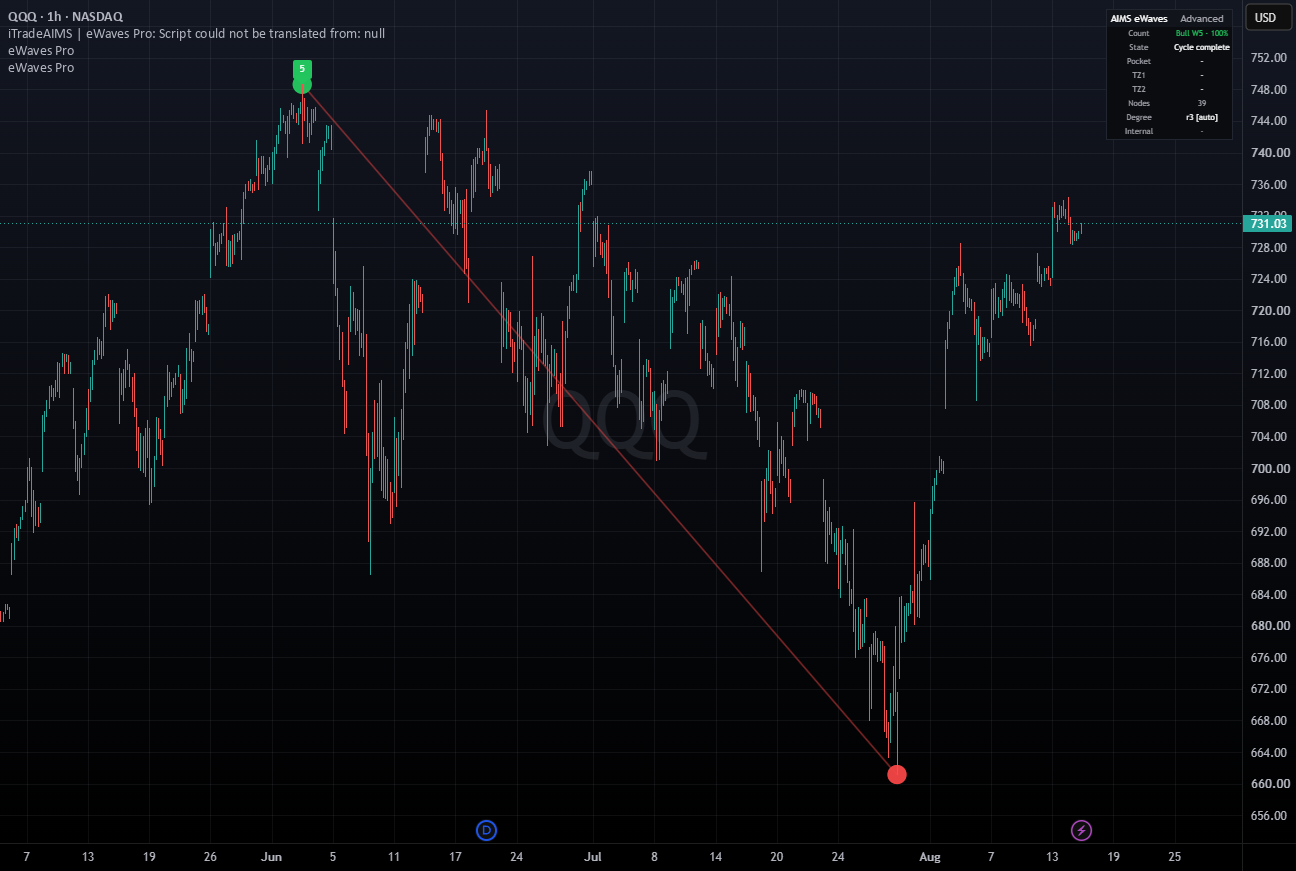
Completed 5-wave cycle locked into historical node chain with full persistence.
The Completed-Cycle Persistence Invariant
Structural node chain persistence locking completed historical cycles.
ConfirmedCycleNodes = LockedHistoryChain
NewHighs NEVER erase historical 1–5 counts; active sub-waves adjust only dynamically
Settings
| Input | Type | Default | What it does |
|---|---|---|---|
| ATR Node Multiplier | Float | 1.5 | Sensitivity factor for detecting structural swing nodes on active chart. |
| Max Degree Hierarchy | Integer | 3 | Number of simultaneous nested wave tiers tracked (Micro, Minor, Intermediate). |
| Display Rival Counts | Boolean | false | Enables visual ghost labels for secondary competing wave interpretation. |
| Minimum Confidence Threshold | Integer | 70 | Suppresses low-probability wave classifications during erratic market chop. |
| W4 Forecast Pocket | String | 38.2%-50.0% | Mathematical Fibonacci cluster box projected for Wave 4 pullback termination. |
| Target Zones (TZ1 & TZ2) | Boolean | true | Renders institutional target corridors ahead of active Wave 5 extensions. |
| Input | Type | Default | What it does |
|---|---|---|---|
| InpSerialKey | string | "" | DLMS serial key license activation. |
| InpAtrMultiplier | double | 1.5 | Sensitivity factor for structural swing node detection. |
| InpMaxDegrees | int | 3 | Number of nested wave tiers tracked simultaneously. |
| InpShowRivalCounts | bool | false | Display ghost markers for competing wave hypothesis. |
| InpMinConfidence | int | 70 | Minimum algorithmic rating threshold percentage. |
| InpTargetZones | bool | true | Render mathematical TZ1 and TZ2 target projection corridors. |
| Input | Type | Default | What it does |
|---|---|---|---|
| InpSerialKey | string | "" | DLMS serial key license validation. |
| InpAtrMultiplier | double | 1.5 | ATR sensitivity factor for swing nodes. |
| InpMaxDegrees | int | 2 | Max wave degrees displayed on chart. |
| InpMinConfidence | int | 70 | Minimum confidence threshold rating. |
| InpTargetZones | bool | true | Plot TZ1 and TZ2 projection corridors. |
Use it in your EA
On MetaTrader you can read the levels and setup state from an Expert Advisor with iCustom().
// MQL5 — Read AIMS eWaves Pro structural node chain telemetry on confirmed bar close
int    h = iCustom(_Symbol, _Period, "AIMSeWavesPro");
double primaryNode[], waveDegree[], confidence[], rivalNode[];
CopyBuffer(h, 0, 1, 1, primaryNode); // Buffer 0: Primary active wave node price
CopyBuffer(h, 1, 1, waveDegree);  // Buffer 1: Wave degree index (0=Micro, 1=Minor, 2=Intermediate)
CopyBuffer(h, 2, 1, 1, confidence);  // Buffer 2: Algorithmic confidence rating (0–100%)
CopyBuffer(h, 3, 1, 1, rivalNode); // Buffer 3: Secondary competing rival hypothesis price| Buffer | Name | Value |
|---|---|---|
| 0 | Primary Node Price | Active structural wave node price level |
| 1 | Wave Degree Index | 0 = Micro degree, 1 = Minor degree, 2 = Intermediate degree |
| 2 | Confidence Score | Algorithmic confidence score percentage (0–100%) |
| 3 | Rival Node Price | Secondary competing wave hypothesis price level |
Frequently asked questions
AIMS eWaves Pro is the premier institutional tier of the eWaves family. Unlike oscillator-dependent tools, it uses a price-native ATR-zigzag node chain to continuously track multi-degree nested waves, evaluate rival counts with algorithmic confidence scoring, and maintain historical cycle persistence.